Independent design concept. Not affiliated with Serina Therapeutics, Inc. Official investor relations: investors.serinatx.com

Serina Therapeutics · NYSE American: SER · Huntsville, Alabama

Steadier release for drugs we already know

Serina is a clinical-stage biotechnology company. Its POZ technology links existing drugs to a synthetic polymer, poly(2-oxazoline), engineered to give more control over how much drug is attached and how fast it is released after a long-acting subcutaneous injection. The lead candidate, SER-252, is apomorphine on that polymer, now in a Phase 1b registrational study in advanced Parkinson’s disease. 10-K, Mar 25, 2026

Schematic: drug released one copy at a time from a polymer backbone, and the resulting exposure lineTop: a polymer backbone with ten side chains, each carrying one drug bead; the beads detach one after another. Bottom: a dashed line showing the repeated peaks and troughs of ordinary dosing against a shaded therapeutic window, and a solid line that rises into the window and stays inside it. A schematic after the company’s own diagram, not trial data. Polymer, drug on its side chains Therapeutic window
Ordinary dosing: peaks and troughs The design goal: exposure that stays in the window Shaded band: the therapeutic window Top: drug beads on the polymer backbone Schematic after the company’s own POZ Platform diagram. Not trial data.
  • 8 patients in Cohort 1 of the SER-252 study, at the lowest dose. The independent safety committee recommended moving to Cohort 2. 8-K, Sep 9, 2026
  • $23.0M in cash and cash equivalents at Jun 30, 2026, up from $3.1M at Dec 31, 2025. 10-Q, Aug 13, 2026
  • 25.4M shares of common stock outstanding at Aug 10, 2026 (25,400,473 on the 10-Q cover), up from about 10.8 million at Dec 31, 2025. 10-Q, Aug 13, 2026
  • H1 2027 when the company expects topline data from the single-ascending-dose part of the study. It is an expectation, not a commitment. 8-K, Sep 9, 2026

The platform

The drug sits on the polymer’s side chains, not only at its ends

POZ is a water-soluble, low-viscosity polymer made from 2-ethyl- or 2-methyl-2-oxazoline. Serina attaches copies of an existing drug to it, and the company believes this can let a single subcutaneous injection deliver the drug continuously. 10-K, Mar 25, 2026

Schematic: where the drug sits on PEG and on POZTop chain, PEG: one drug bead at each of the two chain ends. Bottom chain, POZ: ten drug beads along the side chains. The counts are those the company states in its annual report; the drawing is a schematic, not to molecular scale.

PEGDrug copies sit at the two chain ends only: n = 1 or 2.

POZDrug copies sit along the side chains: n = 10 or higher, and the company says the number of attachment points can be controlled.

Counts as stated in the 10-K. A schematic, not to molecular scale.

  1. 01

    Attach

    Ten or more copies of the drug are bonded to the side chains of one polymer backbone. Higher drug loading per polymer means, the company says, that less polymer is needed to deliver the same amount of drug.

  2. 02

    Inject

    The conjugate is a long-acting subcutaneous injection. The company believes SER-252 may be given at home, as a single or twice-weekly injection, without a healthcare provider.

  3. 03

    Release

    Programmable linkers let the drug come off the polymer slowly. The company reports that in animal studies POZ programmed the release of small molecules. For SER-252 in people, the first look is the blinded Cohort 1 pharmacokinetic profile, which it calls consistent with prolonged apomorphine exposure. 8-K, Sep 9, 2026

What the company says sets POZ apart from PEG

  • 01

    More drug per chain

    PEG carries one or two copies of a drug, at its ends. POZ carries ten or more along the side chain.

  • 02

    No antibodies to the polymer, so far

    Repeat dosing of POZ in rabbits did not generate anti-POZ antibodies, and the Phase Ia study of SER-214 showed no toxicity concerns.

  • 03

    Cleared, not stored

    In preclinical IND-enabling studies in rodents and monkeys, POZ was cleared by the kidneys as an intact polymer, with no evidence of accumulation in any tissue. The company says PEG is known to accumulate in several tissues.

  • 04

    Simple to make and keep

    POZ is made in essentially one pot from low-cost monomers, and drug-POZ conjugates can be stored at room temperature or in a refrigerator. PEG starts from ethylene oxide, a flammable, toxic gas.

A limit on all of this. The company has not compared PEG-conjugated and POZ-conjugated molecules in humans. Its comparisons are in vitro and in animals. 10-K, Mar 25, 2026

The need

Oral doses wear off, and the continuous options use a catheter or a pump

Most people diagnosed with Parkinson’s disease are treated with oral levodopa and carbidopa. The 10-K says that in almost all cases of oral treatment patients may experience “wearing off” or a disabling side effect called dyskinesia, and that most oral drugs deliver dopamine stimulation in peaks and troughs. 10-K, Mar 25, 2026

Swipe sideways to read the whole table.

Approaches to dopamine delivery in Parkinson’s disease, as the company’s 10-K describes them
ApproachHow it is givenContinuous?What the 10-K says
Oral levodopa-carbidopaPillsNoThe company says most oral drugs deliver dopamine stimulation in a peak and trough fashion, and that animal studies suggest this may lead to dyskinesia. It describes wearing off separately, as the drug failing to deliver enough stimulus.
Duopa (levodopa-carbidopa gel, AbbVie)Infusion into the small intestine through a surgically placed catheterYesIn a double-blind, double-dummy study in advanced patients it added about two hours a day of ON time without troublesome dyskinesia against oral sustained-release capsules. The company calls the approach invasive.
Vyalev (foslevodopa-foscarbidopa, AbbVie)Continuous subcutaneous infusion with an electronic pumpYesApproved by the FDA in October 2024; the company calls it a substantial new treatment option.
SER-252 (apomorphine on POZ), investigationalSubcutaneous injection; the company believes single or twice weekly, at homeDesigned to beIn a Phase 1b study and not approved. The company has so far reported only blinded Cohort 1 observations.

Continuous dopaminergic stimulation (CDS) has been shown, the company says, to reduce the severity of levodopa-related motor complications. SER-252 is designed to deliver it by subcutaneous injection, with the goal of reducing the administration burden of existing continuous infusion approaches. 8-K, Sep 9, 2026

Lead program

SER-252: cohorts of eight, then sixteen

SER-252 is apomorphine, a dopamine agonist, attached to POZ. The SER-252-1b study is randomized, double-blind and placebo-controlled, in adults with Parkinson’s disease and motor fluctuations. It tests safety, tolerability and pharmacokinetics first, with exploratory measures of motor function. 8-K, Sep 9, 2026

Single ascending dose five cohorts of eight, n = 40

Cohort 1

Complete, lowest dose. The company announced the committee’s recommendation to advance on Sep 9, 2026.

Cohort 3

Planned, a higher dose.

Cohort 4

Planned, a higher dose.

Cohort 5

Planned, a higher dose.

Multiple ascending dose up to three cohorts of sixteen, n = 48

Cohort 1

Planned, if the study proceeds.

Cohort 2

Planned, if the study proceeds.

Cohort 3

Planned, if the study proceeds.

SER-252, 6 of 8 (derived from the 3:1 randomization) Placebo, 2 of 8 (derived) Next Planned Sites in the U.S., Australia, South Korea and Taiwan. An independent Safety Monitoring Committee oversees dose escalation, and each cohort tests a higher dose than the one before.

Cohort 1, in the company’s words

“blinded Cohort 1 observations showed a pharmacokinetic profile consistent with the sustained apomorphine exposure SER-252 is designed to provide and included sustained periods of improvement in motor function in individual patients on exploratory clinical measures.”

Serina, Sep 9, 2026 press release. 8-K, Sep 9, 2026

Context the release also gives: during Cohort 1, patients were withdrawn from background Parkinson’s medications under the protocol, so that investigators could characterize pharmacokinetics and motor function with limited contribution from other dopaminergic therapy. Cohort 1 was eight patients at the lowest dose, randomized 3:1 to SER-252 or placebo.

The record since the hold

  1. The FDA places a clinical hold on the SER-252 IND. It asked for more information on a commonly used excipient in the formulation, not on the active drug or its mechanism. 8-K, Nov 3, 2025

  2. Serina submits its complete response to the FDA’s clinical hold letter dated Nov 25, 2025, and announces it on Dec 10. 8-K, Dec 10, 2025

  3. Serina announces that the FDA has cleared the IND. 8-K, Jan 28, 2026

  4. The first patient is enrolled and dosed in the Phase 1b study. 10-K, Mar 25, 2026

  5. Sentinel dosing in Cohort 1 is complete, per the company’s news release. News index

  6. Enrollment and dosing in Cohort 1 are complete, per the company’s news release. News index

  7. After a blinded review, the independent Safety Monitoring Committee recommends the study advance to Cohort 2. 8-K, Sep 9, 2026

  8. Expected: topline data from the single-ascending-dose part of the study. The company says so; it is not a result.

Partners and the platform beyond SER-252

One delivery partner for SER-252, one license for the platform

Serina’s business is largely a wholly owned pipeline of POZ-enabled drug candidates, and it intends to take other uses of POZ forward through out-licensing, co-development and other partnerships. 10-K, Mar 25, 2026

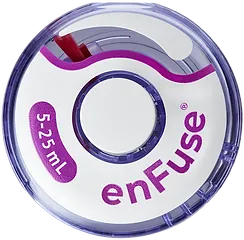
The enFuse wearable on-body drug delivery device, a round white and violet disc
enFuse® is a registered trademark of Enable Injections, Inc. Image as shown on the company’s website.

Delivery partner · May 2024

Enable Injections

In May 2024 Serina entered a partnership with Enable Injections, Inc. to develop and commercialize SER-252 together with enFuse, a wearable drug delivery system for at-home self-administration. The company describes enFuse as designed to overcome the shortcomings of IV infusion and of other subcutaneous methods. 10-K, Mar 25, 2026

Earlier candidate

SER-214

POZ-rotigotine for early Parkinson’s disease and restless legs syndrome. It completed a Phase Ia study in 19 subjects as a proof of principle for POZ in humans, is not being advanced internally, and may be out-licensed.

License · October 2023

Pfizer

A non-exclusive license to use POZ in lipid nanoparticle drug delivery formulations, for a specific POZ polymer structure in one field. It followed two years of work, from early 2021, with several large pharmaceutical and biotechnology companies under agreements the 10-K calls FSAs, on POZ-lipids as a replacement for PEG-lipids in mRNA vaccines.

Other uses · intent to license

RNA delivery and antibody-drug conjugates

The company intends to license POZ to others developing lipid nanoparticle approaches in infectious diseases, cancer immunology and gene therapy, and describes POZ as applicable to antibody-drug conjugates. None of these programs is the company’s own.

The company’s 8-K press releases, most recently on Mar 25, 2026, describe SER-270 as an investigational once-weekly VMAT2 inhibitor for tardive dyskinesia and say the company is also exploring Huntington’s disease chorea. The Nov 13, 2025 release said it was on track to complete formulation optimization and pre-IND activities in 2026, while the investor site still says it is anticipated to enter IND enabling studies in the fourth quarter of 2025. The 10-K does not name it, so it is not counted in the pipeline above. 8-K, Nov 13, 2025 8-K, Mar 25, 2026

Financials

Cash rose to $23.0M, and most of it came from new shares

Serina has no product revenue. Its revenue is grant revenue: $130 thousand in 2025 and none in the first half of 2026. In the six months to Jun 30, 2026 it used $11.3 million in operating activities and raised $21.1 million net in a private placement and $10.2 million net in at-the-market sales. 10-Q, Aug 13, 2026

Cash there to use

$3.1M opening cash, Dec 31, 2025$21.1M private placement, net$10.2M at-the-market sales, netoption exercises and exchange effect, 23 thousand

What became of it

$11.3M used in operating activitiesinvesting, 53 thousand$23.0M cash at Jun 30, 2026
Opening cash
3,056
Private placement, net
21,081
At-the-market sales, net
10,169
Option exercises
9
Exchange effect
14
Operating activities
(11,252)
Investing activities
(53)
Cash at Jun 30, 2026
23,024
Both bars are the same length: the cash that was there to use ($3.1M at Dec 31, 2025 plus what came in) equals what went out plus $23.0M left at Jun 30, 2026. Segments are drawn to the reported values; the two smallest are wider than their scale so they can be seen. Labels are rounded; exact figures are in the table below. 10-Q cash flow statement
Statements of operations, USD thousands, years ended Dec 31 · as filed
 20252024
Grant revenues13056
Research and development13,1557,480
General and administrative10,9979,624
Total operating expenses24,15217,104
Loss from operations(24,022)(17,048)
Net loss attributable to Serina(19,182)(11,141)
Statements of operations, USD thousands, six months ended Jun 30 · as filed
 20262025
Grant revenues0130
Research and development7,0156,103
General and administrative6,0495,450
Total operating expenses13,06411,553
Loss from operations(13,064)(11,423)
Net loss(13,254)(11,284)
Cash used in operating activities(11,252)(8,072)
Balance sheet, USD thousands · as filed
 Jun 30, 2026Dec 31, 2025
Cash and cash equivalents23,0243,056
Total assets25,8146,951
Convertible note, net3,0872,946
Total liabilities7,0846,988
Total stockholders’ equity (deficit)18,730(37)
Accumulated deficit(76,754)(63,500)

Inside the numbers

  • 2025. A loss from operations of $24.0 million became a net loss of $19.2 million because of $4.8 million of other income, mostly non-cash changes in the fair value of warrant liabilities (4,263 thousand) and a gain on warrants that expired (724 thousand). 10-K, Mar 25, 2026
  • First half of 2026. A loss from operations of $13.1 million became a net loss of $13.3 million. Other items netted to (190) thousand: a non-cash gain on the tranche liability of 1,377, a gain on warrants of 154 and other income of 287, less a non-cash loss of 1,616 on ending the commitment under the 2025 convertible note and interest of 392. 10-Q, Aug 13, 2026
  • Net loss to common stockholders. It was (15,867) thousand in the first half of 2026, larger than the net loss, mostly because of a non-cash deemed dividend of 2,539 thousand on the Series A preferred stock when its conversion price was reset. 10-Q, Aug 13, 2026

How the 2026 cash was raised

  1. Private placement. Common stock and pre-funded warrants at $2.25 a share, each with a redeemable warrant for 50% of the shares at $5.00 for four years. It was led by a member of the board. Gross proceeds received: $21.2 million. $15.0 million funded on Mar 19 and 20 (the first tranche), then $1.0 million on Mar 23 and $5.2 million on Apr 8 (the second tranche). The remaining $8.8 million of the second tranche expired unexercised in April. 8-K, Mar 23, 2026 10-Q, Aug 13, 2026
  2. More authorized shares. Authorized common stock rose from 40,000,000 to 125,000,000 shares after stockholder approval. 8-K, Jun 24, 2026
  3. Series A preferred converted. A limited portion converted in May and the rest after the Jun 17 stockholder vote, together about 2.3 million common shares at a conversion price of $2.25, reset from $5.18. The series was eliminated from the charter on Oct 5, 2026. 8-K, Oct 9, 2026 10-Q, Aug 13, 2026
  4. Equity line. Roth Principal Investments, LLC agreed that, once a resale registration statement is declared effective, Serina may direct it to buy up to $25.0 million of new shares over up to 36 months. The price is a 7% discount to the volume-weighted price until $12.5 million has been sold, then 3% for market-open and intraday purchases or 5% for pre-market and post-market purchases. Serina has no obligation to sell. Sales to Roth are capped at 5,077,554 shares (19.99% of the shares outstanding before the agreement) unless stockholders approve more or the price paid equals or exceeds $2.7695 a share. 8-K, Aug 27, 2026

Disclosures

What the filings say about risk

Seven matters a reader should have in front of them. Each is in the company’s own filings, and each carries its source.

01

Going concern

“Management believes that its cash and cash equivalents of $23.0 million as of June 30, 2026 are not expected to be sufficient to satisfy the Company’s anticipated operating and other funding requirements for the twelve months from the issuance of these unaudited condensed consolidated interim financial statements. As such, there is substantial doubt about the Company’s ability to continue as a going concern.”

The 10-K for 2025 reached the same conclusion when cash was $3.1M, and its risk factors say the auditor’s report contains a qualification to that effect. The company expects to rely largely on raising money from equity investors. 10-Q, Note 1 10-K, Mar 25, 2026

02

Funding and dilution

Shares outstanding rose from about 10.8 million at Dec 31, 2025 to 25,400,473 at Aug 10, 2026. The March 2026 private placement came with redeemable warrants at $5.00 a share and pre-funded warrants, and the company has since agreed an equity line of up to $25.0 million at a discount to market. The company says the exercise of outstanding warrants and other issuances could result in substantial dilution. 10-Q, Aug 13, 2026 8-K, Aug 27, 2026

03

NYSE American listing

On Jan 9, 2026 the exchange told the company it was below its stockholders’ equity requirements: about $1.6 million at Sep 30, 2025 against $2.0 million and $4.0 million thresholds. The exchange accepted the company’s compliance plan on Mar 24, 2026, which permits the stock to remain listed during a plan period ending Jul 9, 2027, subject to periodic review including quarterly monitoring. The company says there can be no assurance it will maintain compliance, and that delisting proceedings may follow if it does not. Equity was about $18.7 million at Jun 30, 2026. 8-K, Jan 15, 2026 10-Q

04

Two closely aligned large holders

On Aug 10, 2026 Juvenescence Limited beneficially owned about 17% of the common stock and Gregory H. Bailey, a director and Co-Chairman, about 41%, each counting shares issuable on exercising warrants. Dr. Bailey is Juvenescence’s executive chairman and a co-founder, and another director is its chief executive. The company says their interests are closely aligned and that, if they act together, they can control or substantially influence stockholder votes, and that conflicts of interest may arise. The 10-K gave Juvenescence about 33.0% on Mar 1, 2026, before the March 2026 placement. The lead investor in that placement was also a board member. 10-Q, Aug 13, 2026 10-K, Mar 25, 2026

05

The clinical hold, now lifted

The FDA placed a clinical hold on the SER-252 IND on Nov 3, 2025, and Serina announced on Jan 28, 2026 that the FDA had cleared it. The company says the FDA’s feedback concerned a commonly used excipient and did not relate to the active drug substance or its mechanism. It also warns that the FDA approval process is lengthy and unpredictable, and that delays are possible. The dated record

06

No product revenue yet

Serina’s revenue so far is grant revenue: $130 thousand in 2025 and none in the first half of 2026. The company says it is uncertain when, if ever, it will realize revenue from product sales, and that it expects to rely largely on raising capital from equity investors, with some funding possibly from licensing agreements. 10-Q, Aug 13, 2026

07

Early, small and blinded

Cohort 1 enrolled eight patients, randomized 3:1 to SER-252 or placebo, at the lowest dose of a Phase 1b study. The company says preliminary results from its nonclinical studies and clinical trials may change as more patient data becomes available and the data is audited and verified. 10-K, Mar 25, 2026 8-K, Sep 9, 2026

The record

What the company announced, and what it filed

The left column is the company’s own news list. The right column is the filing behind each item, on EDGAR. Where the two differ, the filing governs.

From the company

  1. Registration opens for Tribe Public’s CEO presentation and Q&A webinar on SER-252’s clinical progress.

  2. Serina to present at the H.C. Wainwright 28th Annual Global Investment Conference.

  3. Cohort 1 observations from the SER-252 registrational study, and advance to Cohort 2

  4. Enrollment and dosing in Cohort 1 complete.

  5. Farrell Simon, Pharm.D., appointed to the board and to its Audit and Compensation Committees.

  6. Sentinel dosing in Cohort 1 complete.

  7. Partner news: Enable Injections announces CE certification of the enFuse® system for use with Aspaveli®, distributed by Sobi.

All company news

Filed with the SEC

  1. 8-K Series A preferred stock eliminated from the charter; none was outstanding.

  2. 8-K Cohort 1 observations, the committee’s recommendation, topline expected in the first half of 2027.

  3. 8-K Common stock purchase agreement with Roth Principal Investments, up to $25.0 million.

  4. 10-Q Second quarter report, and the 8-K earnings release.

  5. 8-K The chief executive’s employment agreement amended and restated.

  6. 8-K New director appointed.

  7. 8-K Authorized common shares raised from 40,000,000 to 125,000,000.

  8. 10-Q First quarter report.

  9. 10-K Annual report for 2025.

  10. 8-K The March 2026 private placement agreement, at $2.25 a share.

  11. 8-K Announces that the FDA cleared the SER-252 IND.

  12. 8-K NYSE American notice on stockholders’ equity.

All filings on EDGAR

Contact IR

Go to the company’s own investor site

This concept page is not Serina’s. For the company’s official news, presentations, alerts and contact form, use the sources below.

Investor email alerts

The company’s investor site, investors.serinatx.com, offers sign-up for alerts on news, quarterly and annual reports, SEC filings, events and presentations, and the end-of-day stock quote.

Open the investor site

Investor relations

Telephone
(256) 327-9630, as shown on the investor site and the 10-K cover
Address on the 10-K cover
601 Genome Way, Suite 2001, Huntsville, Alabama 35806

Presentation and filings

The investor site lists a corporate presentation, “Serina POZ Small Molecule Platform Introduction”, dated Sep 9, 2026. Its filings are on EDGAR.

SEC filings (EDGAR)